Oops — An AI Said Why it was Wrong

Large language models (LLMs) are wonderful tools, but they sometimes make important mistakes. This informal note shows a stream of incorrect responses from Perplexity (a generally great resource) when we asked it about a rental property. Despite a series of follow-up questions and prompts to provide additional accurate and definitive information, the LLM continued to confidently and persistently get the facts wrong. This note traces the causes and conditions that caused the errors.

When an LLM appears to “reflect” on an answer, it does not build, test, refine, or correctly explain a realistic model of the world like a curious and responsible person can. It may incorrectly combine information from outdated sources. It can be difficult for a user to know if, when, and why LLM responses are incorrect. In this example the LLM exhibits great but misplaced confidence in its answers.

With further prompting Perplexity provided previously published explanations about why LLMs can confidently give incorrect responses. LLM technology is the product of impressive effort and engineering. Nonetheless, it should be used with caution This note illustrates how its mistakes occur.

Full Post: https://www.dropbox.com/scl/fi/kk0d9y8i5oyi93im0c6o3/2025-10-28-Oops-An-AI-Said-Why-it-was-Wrong.pdf?rlkey=aj0bci6ccgfwnnd1g2n16vi4b&dl=0

Posted in AI Engineering, Artificial Intelligence, Uncategorized | Leave a comment

How AI Engineering Addresses Sensemaking, Reasoning, and Explainability

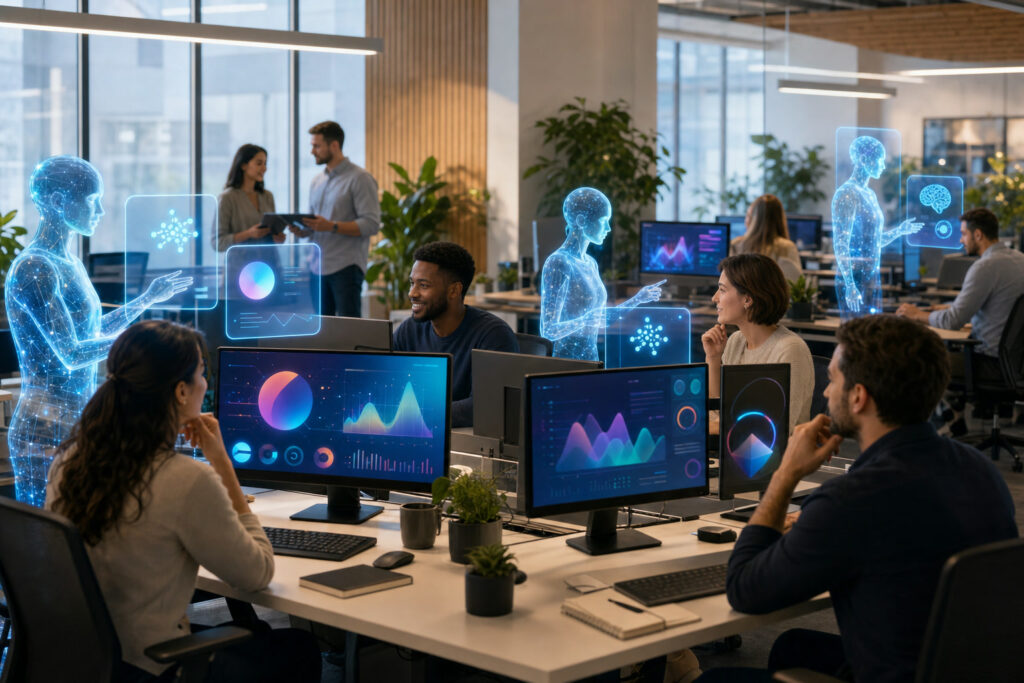
AI technology is powerful but imperfect. Its complexity and imperfections have led to rapidly developing AI engineering (AIE) practices that provide more than off-the-shelf AI technology for building AI applications. 

This paper explains current AI technology and AI Engineering in terms of sensemaking, reasoning, and explainability.

  • Sensemaking is collecting, organizing, summarizing, and extracting information. Sensemaking leverages the utility of LLMs for finding patterns in data combined with the oversight and experience of people in the loop.
  • Reasoning is about modeling how the world works, planning, and taking actions. It is needed for scheduling, design, manufacturing, construction, logistics and other complex activities. Reasoning leverages computation to sort through options and constraints to find optimal combinations.

State-of-the-art AIE practice employs design patterns for creating AI systems (“agentic systems”) that apply diverse knowledge and constraints to generate and cross-check their actions and conclusions.

This paper explains the research breakthroughs, the state of the art, and the whitespace for advancing AIE. It was invited as a follow-on paper to an earlier 2019 paper on XAI (Gunning et al., 2019) that received a Frontiers of Science award at the 2025 ICBS conference in Beijing.

Paper

Stefik, M., Gunning, D., Choi, J., Miller, T., Stumpf, S., Yang, G.-Z. 2025. How AI Engineering Addresses Sensemaking, Reasoning, and Explainability. https://www.dropbox.com/scl/fi/sgqrp0axf1chtijr10899/2025-10-28-How-AI-Engineering-Addresses-Reasoning-and-Explainability.pdf?rlkey=l8ztq319jdjhdq0cw8mia831n&dl=0

Posted in Uncategorized | Leave a comment

AIs and Human-Compatible Values

A widespread public concern is that AIs are not trustworthy because they lack human values. Meanwhile, there has been much less discussion in AI research, education, and policy statements about the nature of values and how they are acquired. Salient insights and questions about values come largely from other disciplines. Not comprehending the context dependent and variable nature of deep values, AI regulators and other stakeholders overestimate the near term prospects for robust guardrails. Without deep competences for communication and collaboration, aspirational future AIs will not learn nuances of human-compatible values.

Stefik, M. (2024) AIs and Human-Compatible Values. DropBox Link (10 pages)

Posted in Artificial Intelligence, Developmental AI, Human-AI Collaboration | Leave a comment

Roots and Requirements for Collaborative AIs

The vision of AIs as human-like collaborators is a staple of mythology and science fiction, where artificial agents with special talents assist human partners and teams. In this vision, sophisticated AIs understand nuances of collaboration and human communication. The AI as collaborator concept is different from computer tools that augment human intelligence (IA) or that intermediate human collaboration. Those tools have their roots in the 1960s and helped to drive an information technology revolution. They can be useful but they are not intelligent and do not collaborate as effectively as skilled people.

With the increase of hybrid and remote work since the COVID pandemic, the benefits and requirements for better coordination, collaboration, and communication are becoming hot topics in the workplace. Employers and workers face choices and trade-offs as they negotiate the options for working from home versus working at the office. Many factors such as the high costs of homes near employers are impeding a mass return to the office.

Government advisory groups and leaders in AI have advocated for years that AIs should be transparent and effective collaborators. Nonetheless, robust AIs that collaborate like talented people remain out of reach. Are AI teammates part of a solution? How artificially intelligent (AI) could and should they be?

This position paper reviews the arc of technology and public calls for human-machine teaming. It draws on earlier research in psychology and the social sciences about what human-like collaboration requires.

Publications

Stefik, M. (2023) Roots and Requirements for Collaborative AIs  (24 pages) arXiv  http://arxiv.org/abs/2303.12040

Posted in Artificial Intelligence, Human-AI Collaboration | Leave a comment

What AIs are not Learning (and Why)

Today’s robots do not learn the general skills needed for such services as providing home care, being nursing assistants, or doing household chores. Addressing such aspirational goals requires improving how AIs and robots are created. Today’s mainstream AIs are not created by agents learning from experiences doing real world tasks and interacting with people. They do not learn by sensing, acting, doing experiments, and collaborating. This paper investigates what aspirational service robots will need to know. It recommends developing experiential (robotic) foundation models (FMs) for bootstrapping them.

Publications

Stefik, M. (2025) “What AIs are not learning (and Why).” AI Magazine 46:e12213. https://onlinelibrary.wiley.com/doi/epdf/10.1002/aaai.12213

Posted in Artificial Intelligence, Developmental AI | Leave a comment

Bootstrapping Developmental AIs

Developmental AI creates embodied AIs that develop human-like abilities. In a bootstrapping approach to developmental AI, the AIs start with innate competences and learn more by interacting with the world including people. Developmental AIs have been demonstrated, but their abilities so far do not surpass those of pre-toddler children.

In contrast, mainstream approaches have led to impressive feats and commercially valuable AI systems. The approaches include deep learning and generative AI (e.g., large language models) and manually constructed symbolic modeling. However, manually constructed AIs tend to be brittle even in circumscribed domains. Generative AIs are helpful on average, but they can make strange mistakes and not notice them. Not learning from their experience in the world, they can lack common sense and social alignment.

The paper below lays out prospects, gaps, and challenges for developmental AI. The goal is to create data-rich experientially based foundation models for human-compatible AIs. A virtuous multidisciplinary research cycle has led to developmental AIs with capabilities for multimodal perception, object recognition, and manipulation. Computational models for hierarchical planning, abstraction discovery, curiosity, and language acquisition exist but need to be adapted to an embodied learning approach. The competence gaps involve nonverbal communication, speech, reading, and writing.

Aspirationally, developmental AIs would learn, share what they learn, and collaborate to achieve high standards. They would learn to communicate, establish common ground, read critically, consider the provenance of information, test hypotheses, and collaborate. The approach would make the training of AIs more democratic.

Publications

Stefik, M., Price, R. (2023) Bootstrapping Developmental AIs (112 pages) arXiv  http://arxiv.org/abs/2308.04586

Posted in Artificial Intelligence, Developmental AI | Leave a comment

Creating the Conditions for Invention and Innovation — Revisited

When I was asked to lead the Intelligent Systems and Technology Lab at the Palo Alto Research Center (PARC), I wanted the lab to succeed wonderfully in its research mission. I was a fairly prolific inventor and had taken multiple tours of duty as a research manager. I set out to open my mind to possibilities for effective invention and innovation by interviewing colleagues at PARC and elsewhere about their best practices.

How do you create the conditions under which inventions arise?

I shared insights from the inventor interviews with my wife, Barbara. Soon, she had her own recording device. She joined me on the interviews and did additional ones on her own. Three years later our work led to the publication of our book Breakthrough by The MIT Press.

One of the most interesting questions that we asked and sought to answer was “How do you create the conditions under which inventions arise?” We also asked “How do you create the conditions under which innovations arise?” The distinction is that invention is about developing ideas and innovation is about developing inventions to become products.

Today there are needs and opportunities not only for inventing and innovating, but also for new technologies and ways of inventing and innovating.

It is timely to ask these questions again. Today there are needs and opportunity not only for invention and innovation, but also for new technologies and ways of inventing and innovating.

Example Past Project (Colab)

PARC’s Colab (1989)

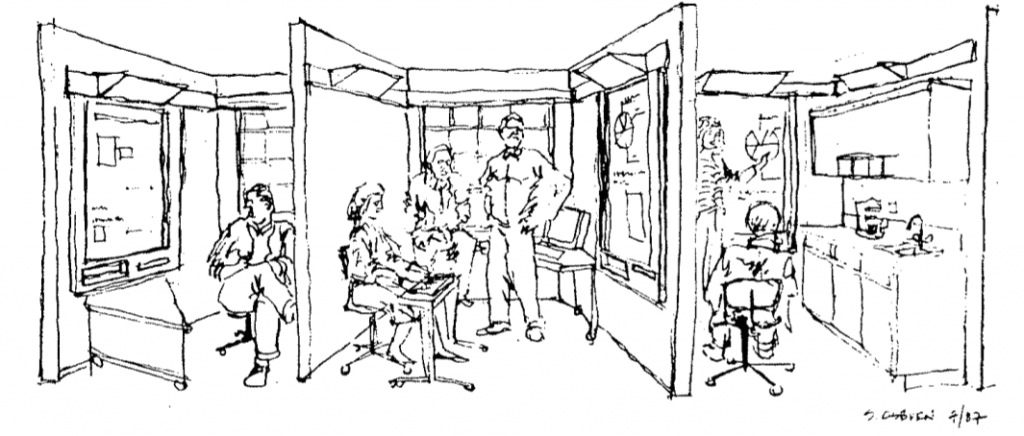
When I came to PARC, I loved the wall-sized whiteboards. We developed group processes of gathering at a whiteboard, brainstorming, and organizing our ideas.  I wanted to speed up the process for rearranging the drawings and symbols on the whiteboard in our intense idea sessions. This led to a DARPA-funded Colab project where we created an electronic meeting room, including a wall-sized projected screen made touch-sensitive by special hardware from the Xerox skunk works.

Portable Ideas and Portable Meetings

Portable meetings and portable ideas were intermediated by interactive whiteboards

We invented WYSIWIS (What You See Is What I See) interfaces and public and shared windows. Our team productivity was accelerated by conversations that combined the familiar one-person-at-a-time audio channel of meetings with computer-intermediated visual elements. The tools also created digital outlines and other records of our work as described in our paper.

Our multi-user Colab tools worked best when we were in the Colab. John Seeley Brown and I saw a possibility (not then technically practical) for creating meetings and idea-structures that were “portable.” They could be resumed, rewound, re-branched, and extended. Our paper “Towards Portable Ideas” imagined how strategically-located interactive whiteboards with a suitable infrastructure could extend the utility and life of conversations as “portable ideas” were created, carried and refined by work groups. This idea on boards, tablets, and other devices is ripe to be realized today.

Design Lab created for the Technology for Agile Organizations (TAO) group at PARC

Colab technology led to a Liveworks PARC spin-out with a “LiveBoard” product, which was expensive at the time. Many years later, using off-the-shelf technology, we built a simpler design lab for stand-up meetings and working design sessions for a smart cities project. Meetings were BYOC (Bring Your Own Computer) and seating was at a stand-up table to encourage high energy interactions.

How can we better support opportunity awareness and powerful conversations for innovation in distributed organizations?

How could a virtual workplace support serendipitous interactions?

Forward to the COVID pandemic. Many workers had completed a year of desk-bound remote working. They practiced sharing screens in online meetings, having targeted side conversations with text messaging, and finding the mute button.

The pandemic has probably accelerated the shift of organizations to geographically distributed forms where teams work at different sites, and more employees work remotely.

But are the remote workers and teams as effective at invention and innovation? Are distributed teams and teams of teams less-powerfully connected and less effective? Are important opportunities being missed?

Despite long hours in meetings, it seemed harder to have the formal and informal conversations afforded by physical workplaces where ideas are seeded and developed.

The pandemic has probably accelerated the shift of organizations to geographically distributed forms, where teams work at different sites, and more employees work remotely.

A physical workplace offers affordances for informal interactions. Meetings around problem solving or idea development are open and attract opportunistic engagement.  Consider a physical office workplace as in the picture. What are its affordances for:

  • Sound boarding ideas
  • Learning about new activities (noticing the “buzz”)
  • Catching up quickly on progress
  • Creating partnerships
  • Onboarding new team members

Current online meeting software is focused on scheduled meetings. The meetings are often not serendipitous, engaging, or effective. Management has little visibility into collaborative engagement opportunities in the virtual workplace. It can not easily see how well today’s remote meeting tools promote collaboration and coordination. People talk about burn out from on-screen meetings all day long.

Especially in regions like Silicon Valley, the limited available land area has led to a dramatic rise in the cost of real estate. This cost creates substantial overhead for businesses and also challenges for new employees who want to buy homes and raise families. In this way, the local concentration of technology development is itself creating economic pressure for policies to allow remote workers. Do we need a new generation of infrastructure for distributed organizations?

Current online meeting software focuses on scheduled meetings. The meetings are often not serendipitous, engaging or effective.

Forward to today. I am the principal investigator of the COGLE (Common Ground Learning and Explanation) project.  COGLE is part of the Defense Advanced Research Projects Agency (DARPA) eXplainable AI program. It is supported  under contract FA8650-17-C-7710.

In writing up findings of a user study about XAI explanation I found myself reflecting on the Stanford DENDRAL project, which routinely solved complex chemical structure elucidation problems. DENDRAL had superhuman performance in solving chemical structure puzzles. Carl Djerassi, a Stanford chemistry professor and inventor of the birth control pill, was one of the leaders of the project. In his autobiography, Djerassi reported on a pedagogical experiment. He assigned his students in a graduate chemistry seminar to use DENDRAL to check the chemical structures that were reported in papers from peer reviewed chemistry journals. Without exception they found that every article had mistakes. The articles presented evidence and identified the chemical structures that were consistent with it. For every article, there was at least one structural alternative that the authors and reviewers had missed. The point is that combinatorial problems are difficult to get right, even when people check each other’s work.

COGLE’s domain is about autonomous drones that carry provisions in mountainous and forested settings to stranded or injured hikers. The connection here is that like DENDRAL, COGLE’s AIs have superhuman capabilities. They find optimal flight plans for missions in a simulation world. One configuration of COGLE is as a decision aid for humans, who choose the best AI-controlled drone for a mission. The AIs at hand have different experiences, know different things, and make different plans.

Typical advantages of human and AI cognition on combinatorial problems in open (O) worlds.

Although COGLE’s AIs are great optimizers, they are limited by the specific experiences in their individual training. The different AIs have different experiences and knowledge. User study participants had to judge when they should trust an AI and when they should not. Sometimes the human — or even the Explainer — can tell that the AI-generated plans have issues.

This application example frames one of the important uses for XAI technology: decision support. People and computers have different advantages and can complement each other on a human plus computer team. There are other cognitive asymmetries and applications as well and studies to understand where and when AIs can best complement humans. Matt Johnson and Alonso Vera make the case that the greater the power of an AI on a team, the greater is its need for skills for collaborating with people. Teaming intelligence is all about team members understanding, supporting, and exploring their interdependence in the partnership.

Closing the Loop refers to AI systems that can both explain and take advice.

At a principal investigator meeting of the XAI program I was asked to lead a panel about a research area beyond XAI called “Closing the Loop” (CTL).  CTL casts XAI as half of a solution. An XAI has deep or other form of machine learning augmented by explanation capabilities. In the other half of a CTL, the AI takes advice and collaborates with people. Ideally, a CTL system can participate in a conversation with users, develop common ground with them, improve knowledge and performance over time, and be a collaborative computational partner. Another technical term for this idea is Interactive Task Learning (ITL).

The panel also considered the DARPA-hard research challenges in creating CTLs. Like XAI, CTL requires multi-disciplinary perspectives to create the AI and to understand the requirements for effective human plus computer teaming.

Disciplines and ideas as pieces for a CTL project.

In his bestseller book Leading Matters, former Stanford University president John Hennessy offered his thoughts on the nature of society’s big challenges — which include such issues as responding to the pandemic, energy, the fragile environment, and others. Such problems do not fall within single disciplines or have easy fixes. They are multi-dimensional and interdisciplinary. Even developing an understanding of such a problem does not fit easily in one person’s mind or their education and experiences. Shared purpose, collaboration and determination are required.

Multi-disciplinary teaming is required to address many of today’s big challenges. Teams that include AIs as partners may become essential — even the norm.

A recent call for action by the National Security Commission on Artificial Intelligence, (Final Report) advances a case for a large and sustained national effort for research and development of AI science and technology. This is another piece of an answer for our opening question.

This post started with the question “How do you create the conditions under which innovation arises?” In the years since our Breakthrough book was published, several things have happened. The world’s problems have become harder, and the technology has advanced. Our unaugmented human minds have not advanced.

Revisiting the question a decade and a half later, we see new opportunity in how to plan our collective journey. The journey involves new tools to support human collaboration in distributed organizations. It also includes developing AI partners to join the team.

Many thanks to Edward Feigenbaum and PARC colleagues for conversations in developing these ideas.

Post by Mark Stefik with contributions from Michael Youngblood

Posted in Creativity, Human-AI Collaboration, Innovation | Leave a comment

A Generation Ready for Human-Computer Teams

Human-computer teams combine best of human and computer cognition. The combination can lead to extremely high performance. But are human-computer teams the future of work?

For some of us, the idea of having computers on the team is outside of normal experience. However, for Millennials, human-computer teaming is the natural next step in a way of life that they have grown up with since they started arriving in 1980. The graphic shows how the technology elements of human-computer teams came into regular use as Millennials grew up.

Fig 3-1 Millennials

For example, Wikipedia arrived in the early years of the first Millennials. It is now the most popular encyclopedia by far. The computer role in Wikipedia is mainly about tracking changes, managing editorial workflow and spotting spamming. However, combined with the human cognition that drives editorial decisions, Wikipedia has now ranked among the top five or ten Internet sites for decades.

The Wikipedia example illustrates a major cultural shift in how Millennials communicate. Computers intermediate most of their communications. Other examples include text messaging, which began in the early 2000’s and took off with smartphones in about 2007. Facebook and other social networks take computer-intermediated communications to new levels – greatly outpacing older technologies like email as more enhanced ways of communication intermediated by computers.

Today the “agent” on the other end of the message or chat may be a messenger bot. “Messaging as a platform” is fueling a new round of start-up funding for services where people make requests from computers via texting or chat programs. Apple’s Siri and Amazon’s Echo are two well-known examples where “your wish is my command” in computer-intermediated services.

How do you get advice today? Computer-intermediated recommendation systems started appearing in the early 2000’s to gather and dispense our collective advice for finding good restaurants and services using Yelp, Angie’s List and many others. Systems that recommend books and movies routinely use computers to hone the relevance of recommendations by modeling our own preferences.

Millennials grew up with computer-intermediated coordination. This is central in multi-player and massively multi-player games (MMORPH), which are now a multi-billion dollar industry. But other computer-coordinated activities include eBay (late 1990’s) for coordinating auctions.

Computers that enable the sharing economy emerged in about 2010 with computer-intermediated coordination enabling people to share rides on Uber, book homes or rooms on AirBnB, and so on. Millennials were the founders and early adopters for these computer-intermediated ways of working and living.

In summary, our world is increasingly computer-intermediated, computer-coordinated, and informed by computer cognition. Human-computer teams are next.

What any of us consider “normal” depends on what we grew up with. For Millennials, these directions are not surprising. Their question is not whether the future of work is human-computer teams. It may be more like, “what’s taking it so long?”


My group at PARC is called TAO, which stands for Theory and Technology for Agile Organizations. We design and implement web services that help organizations optimize their activities, using mobile and cloud technology. Thanks to the CitySight team and our partners for all of the discussions and design that informed this project. Thank you to Matt Darst, Hoda Eldardiry, Bob Krivacic, Lawrence Lee, Raj Minhas, Sai Nelaturi, Mudita Singhal, and Barbara Stefik for comments on earlier versions of this post.

Posted in Human-AI Collaboration, Uncategorized | Leave a comment

What’s the Right Operating System for a Light Bulb?

The typical news today about LED bulbs is about their rapid adoption, their dropping prices, and supporting legislation. The bigger story is about exploiting the IOT (Internet of Things) infrastructure that surrounds them.

IMG_2876Lightbulbs have great established infrastructure. Each receptacle is wired for power. Bulbs have standard screw bases for simple bulb installation.

Light bulbs are everywhere. The average American home has about 40 receptacles for light bulbs. By various estimates there are between 2 billion and 4 billion light bulbs installed in the U.S. That number represents an eighth of the world market.

Traditional incandescent bulbs have a simple function. They glow when they are supplied with power. Manufacturers of LED bulbs are already adding functionality, mostly copying or extending what traditional bulbs do. There are LED bulbs that can dim, ones that can change color, and so on. They can be controlled from a phone or computer via WIFI.

“Smart bulbs” cost more, but they save energy and last longer. A typical LED bulb used three hours per day should last 20 years or more. This long expected product life changes our perception of a bulb from a short-lived disposable to a pricier but long-lived appliance.

What could be incorporated in a light bulb?

  • Think sensors. Motion, light, sound, smoke and heat sensors could be integrated into bulbs.

How could that work if the power to the bulb is off? Suppose that power to a bulb is generally left on but the bulb has a smart circuit that turns the glow on or off. A bulb could glow depending on any number of factors including darkness, detected motion, time of day, sound and commands sent via the WIFI.

Bulbs could have batteries so that they can still perform some actions when their power is off for an extended time, such as emergency lighting or communicating a message through a WIFI. They could trickle charge the battery and run computations without glowing.

Staying close to conventional bulb functionality, lights could adjust brightness according to need. Just say “More light” if you want more brightness and “Lights out” if you want darkness, and so on.

IMG_2879You could even give simple commands through a light switch. Flick the switch twice to turn the glow on. Flick it once to turn glow off. Flick it three times to go to a brightness adjusting mode where each additional flick brightens the glow a little.

How else can we go beyond familiar lighting functions?

  • Think speakers and transducers. Light bulbs could include speakers that provide audio messages. “Johnny says he loves you.”  “The postman left something in the mail box.” “Kids, remember to shut the door.” “Please turn the light switch by the front door back on.”
  • Think cameras and security. Security cameras could be placed in light bulbs at strategic locations. Security bulbs could communicate images of faces or eyes to unlock doors for authorized people.
  • Think fire safety. Light bulbs with built-in smoke or carbon dioxide detectors could function as alarms in many rooms. You should never have to change a battery to stay safe.
  • Think communications and controls like in the Star Trek Next Generation shows. “Computer. Connect me to Number 1.” OK, less stilted language. “Run the dishwasher after 9 PM tonight.” “Take a message for ‘Hot Lips’ when she gets home.” (I’d better stop there.) “Thanks for cleaning the place up. Got any messages for Barbara?”
  • Think lights as  timers for activities — subtly announcing that time is up or that it is time for something.
  • Think games. You hide something for your wife and the lights lead the way.
  • Think nagging. “Ryan, your mom asked you to wash your dishes before you leave.” OK. Don’t think nagging.
  • Think how easy it is to install a light bulb.

So, what is the right operating system for a light bulb? That answer will change with time, but these examples of applications suggest that there is value in supporting multi-processing and other familiar capabilities for embedded systems. Viewed this way, light bulb systems should be developed as a standard part of a system of systems.

What other IOT devices would be useful in light bulb sockets?

Thanks to Eric Bier, Danny Bobrow, Kyle Dent, Raj Minhas, Ashwin Ram, Frank Torres, Michael Youngblood, and Ed Wu for earlier conversations on this. Thanks to Barbara Stefik for providing pictures while I was spending time at the airport writing this.

Posted in Creativity, Innovation | Leave a comment

Smart City Lessons from Shopping Alleys

Doud Arcade off Ocean Avenue (Carmel, CA.)


Doud Arcade off Ocean Avenue (Carmel, CA.)

In Edinburgh they call them “closes”. Other names include arcades, lanes, and alleys. For urban designer Christopher Alexander, an alley is kind of pedestrian street (design pattern #100). A shopping alley is an alley with store fronts. It is often an integral part of a shopping street (pattern #32).

How do shopping alleys work and what can they teach us about designing apps for exploring neighborhoods in smart cities?

Shopping Streets

 Shopping Street in Paris, France.


Shopping Street in Paris, France.

Shopping streets are the hearts of urban neighborhoods. People walk from store to store and enjoy the atmosphere at sidewalk cafes. The attractiveness and safety of these areas is enhanced when pedestrian traffic is separated from vehicle traffic.

Christopher Alexander characterizes pedestrian streets as essential for public life. As he puts it:

“The simple social intercourse created when people rub shoulders in public is one of the most essential kinds of social “glue” in society.” — from A Pattern Language

When a shopping street is well designed, it becomes a magnet, attracting commerce and people from other neighborhoods in a city.

In contrast to well-developed shopping streets, undeveloped alleys can be dangerous and dirty places filled with garbage cans and populated by derelicts. How can well-designed shopping alleys improve livability and shopping streets?

How Can Alleys Improve Shopping Streets?

The Royal Mile in Edinburgh.

The Royal Mile in Edinburgh.

Shopping streets tend to grow at their ends. The Champs-Élysées is an extreme example, stretching over a mile in northwestern Paris from the Arc de Triomphe to The Place de la Concorde near the Louvre. As shopping streets stretch out, the average distance between two stores on the street increases and the street loses its sense of being a compact place to walk and shop.

[pullquote]As shopping streets stretch out, the average distance between stores increases and the sense of a compact area for shopping is diminished.[/pullquote]The main street is the prime real estate and focus of foot traffic. When shopping streets extend sideways to adjacent streets to become shopping districts, there is typically a large drop in foot traffic compared to the main street.

Insights from Optimal Foraging Theory

We can model shopper behavior using optimal foraging theory. Arising from research in ecology, the theory says that organisms forage in a way that maximizes their net energy intake in each unit of time. To model shoppers in this way, we assume that shoppers will seek areas with the most opportunities for buying attractive goods and services in each unit of time.

Example of an undeveloped alley.

Example of an undeveloped alley.

Human shopping behavior has much in common with ancestral patterns for hunting and gathering. As a thought experiment, imagine an early human heading off to a berry patch to gather food. The patch is an attractive destination since much food can be gathered in a short time. Suppose that on the path back from the patch there is a walnut tree. A quick side trip enables harvesting additional food.

[pullquote]A well-designed shopping alley enhances foraging by bringing many small shops into view from a shopping street.[/pullquote]Insights about shopping streets from foraging theory address two points of view. One view is that of the optimizing shopper who goes directly to a destination for a particular item, and also who prefers shopping in a “rich patch” in order to pick up a few things. The second view is that of the shop keeper, who wants to design a place that attracts shoppers. Because the total traffic is the sum of shoppers who come for specific things (the “berries”) and those who are attracted by something they see while foraging (the “walnuts”), shop keepers find an advantage in having their shop be in a rich patch for foraging. To optimize business, they need foot traffic and a means to attract people walking by.

 The alley (in white) can bring small stores C, D, and F within view and easy walking distance for shoppers on Main Street.


The alley (in white) can bring small stores C, D, and F within view and easy walking distance for shoppers on Main Street.

Consider how a developed shopping alley brings a variety of small shops into view from a main street. In the figure above, walkers who stay on Main Street would go by stores A, B, and E in order. The shopping alley (shown in white) brings stores C, D, and F within ready view and easy walking distance. It invites us to explore them. Exploring a shopping alley is much easier than walking around the block to more remote stores. Stores C and D off Main Street are more visible and visited than stores H, I, J, L, M, and N on the cross streets or side streets.

Because they invite exploration of many options in a short time, shopping alleys provide a richer foraging experience than a simple main street.

Elements of Attractive Shopping Alleys

[pullquote]A shopping alley increases the density of attractive shops and improves the foraging experience.[/pullquote]A shopping alley provides a rich opportunity for foraging. Consider the Doud Arcade in Carmel, California shown in the first photo above. The arcade opens off Ocean Avenue, which is the main shopping street in Carmel. The arcade has skylights. Lighted displays of goods and store windows on the alley’s exterior walls attract people to alley stores. Compare this photo to the undeveloped alley above in Palo Alto, California, where shoppers walk quickly by hurrying to the next interesting offering on the street.
Carmel Map PIcsAs a tourist destination in California, Carmel has developed Ocean Avenue to enhance the town’s appeal. The diagram above shows both Doud Arcade and a courtyard on the same block. The restaurants and stores on these shopping alleys are more accessible for foraging than stores on 7th Avenue which is the next street over.

 El Paseo (The Walk) in Sonoma, California.


El Paseo (The Walk) in Sonoma, California.

El Paseo (meaning “The Walk”) in Sonoma, California, is a shopping alley off the main square shopping street. Like the Doud Arcade in Carmel, the entrance has signs and decorations intended to attract walkers to explore as they encounter it on the main street.

 Paisley Close  on the Royal Mile in Edinburgh, Scotland.


Paisley Close on the Royal Mile in Edinburgh, Scotland.

The Old Town of Edinburgh, Scotland, is the oldest part of Scotland’s capital city. The Royal Mile is the main artery and shopping street that runs down from Edinburgh Castle. Many small alleyways — courts, entries, and wynds branch off the road. These are generically called closes. Some of them lead to museums, stores, restaurants and other points of interest. Closes tend to be narrow, although many of them open up to courtyards. Paisley Close shown on the left leads to a Celtic Craft Centre.

 Unimproved alley in the old town of "Mayfield."


Unimproved alley in the old town of “Mayfield.”

Alleys in many towns are a carry over from earlier times when they were used for deliveries and trash pickup. In Mountain View, California and the California Avenue area of Palo Alto (originally the town of Mayfield), alleys lead to parking lots a block off the main street. In such areas the potential of alleys is just being recognized. Development as shopping alleys would require remodeling underused sections of buildings in order to provide space for small shops.

The elements of “bad alleys” are well known. They may be dirty and unpaved. They may have garbage cans. Beyond the obvious cosmetics, successful shopping alleys are arranged so that people on the main street can see at a glance what they have to offer. At a minimum they have signage about the stores or restaurants. Beyond that they may have windows into the stores or lighted displays of goods available down the alley. In the main, the successful shopping alleys enrich the forage experience of walkers by giving them an easy way to get a sense of what is available on a short side trip.

Renewing Alleys as Public Spaces

Evening music in a new public space in Palo Alto created from reworked alleys and new construction.

Evening music in a new public space in Palo Alto created from reworked alleys and new construction.

[pullquote]Many cities are developing all kinds of alleys to improve urban livability.[/pullquote]Seattle, Chicago, Palo Alto and many other cities are re-developing all kinds of alleys to bring vitality to their neighborhoods and to improve urban livability. As in the Palo Alto photo on the left, downtown alleys and new construction have been combined to create public areas that are now a vibrant part of the night life.

In Seattle, the Alley Network Project is working with neighbors, businesses and community groups to revitalize alleys. They studied how neighborhoods in the U.S. and abroad have revitalized their alleys. A group at the University of Washington Green Futures Lab developed The Seattle Integrated Alley Handbook: Activating Alleys for a Lively City to help people re-imagine their alleys and make them lively, healthy, safe and environmentally friendly.

In San Francisco, The Linden Living Alley offers a book that describes design patterns for alleys. They have found that revitalized alleys not only improve shopping and livability, but they can also provide spaces for incubating cottage industries. The Downtown Denver Partnership is making plans to revitalize alleys along Denver’s famous 16th Street Mall. In Chicago, the Green Alley Handbook documents the city’s plans for managing alleys, handling waste water and heat issues, and generally making neighborhoods in the city more livable. In New York, the Voices celebrates the alley with a back street history of New York communities.

Applying Shopping Alley Principles to Smart City App Design

View above fountain from the Spanish Steps (Piazza di Spagna) in Rome.

View above fountain from the Spanish Steps (Piazza di Spagna) in Rome.

Even though alleys are so small, the principles behind their design patterns can inform design for smart cities.

Alley renewal projects recognize and make use of existing city resources. In the same way, although there is much news about experimental smart cities and the trend toward mega-cities, most projects for smart cities in the next decades will be retrofitting and renewal. We are challenged to recognize the resources already present and to incorporate them into a vision of renewal.

As Christopher Alexander put it, shopping streets and other pedestrian ways provide a setting for much of our social glue. The enjoyment that people experience in these areas contributes to a sense of livability for neighborhoods. As in the photo from the Spanish Steps in Rome, people go to shopping streets to see and be seen. When we are on a shopping street, we see friends, we see what people are doing, how busy it is, whether the restaurants and shops are open, and so on.

Consider the two adjacent cities Palo Alto and Menlo Park on the San Francisco peninsula. In the evening, Palo Alto is alive with coffee shops and restaurants. People walk about in groups and couples. They pitch deals and discuss business over laptops everywhere at tables on the sidewalk at coffee houses and restaurants along University Avenue. Although Santa Cruz Avenue in Menlo Park has a number of stores and restaurants, except near El Camino Real it is much quieter on most nights. As a friend quipped, “They roll up the sidewalks in Menlo Park”.

[pullquote]Increasingly we use apps as our lenses for seeing things at the scale of cities. But there are too many of them and they do not convey a sense of place.[/pullquote]Other than by going there, if you did not know the peninsula and were looking for a place to dine or shop, how could you anticipate this difference between the cities? Increasingly we use the virtual world and social media as lenses for seeing things at the scale of cities.

There are dozens of apps for cities in many urban centers. There are apps for finding parking, apps for finding restaurants and making reservations, apps and web pages for finding out about stores, apps to guide travel by car, bus, or bike, apps for local news, apps for community participation, and so on. But that’s actually the problem. Such a pile of apps does not convey a sense of place.

[pullquote]At the scale of cities, an app should support foraging at the next level — finding attractive neighborhoods[/pullquote].Looking at patterns of well-designed shopping alleys provides some design hints. Shopping alleys make it easy to get an overview. They invite us to explore. At the scale of cities, an app should support foraging at the next level — finding attractive neighborhoods. It needs an intuitive interface that tells us about the following:

    • Where are the neighborhoods?
    • What kinds of stores and restaurants are there?
    • Are stores open now or closed?
    • Are the public spaces busy or deserted now?
    • Are there any events happening now or shortly?
    • What is the buzz about in this area?
    • How can I best get there?
    • Do I need reservations for dinner, a show, or parking?
    • If I want to shop, how can I quickly get a sense of selection and pricing?

Top designers of apps and web pages bring an understanding of information foraging theory to their designs. The theory says that people rely on “information scent” or context of nearby information to help them navigate and choose which links to click. The design challenge is to create an app for exploring information about smart cities that is as easy and efficient as walking on a shopping street. Such an app would encourage people to explore their city like they explore their neighborhoods.

The Challenge

Cafe Borrones in Menlo Park in the afternoon.

Cafe Borrones in Menlo Park in the afternoon.

[pullquote] The design challenge is to provide foraging and social experiences at city scale as natural as walking on a shopping street and exploring its shopping alleys.[/pullquote]Many people point to European cities built before cars became prevalent as favorite places for pedestrians. As one of its customers said about Cafe Borrone’s in Menlo Park, you go there “because Europe is too far to go for lunch”. As a German colleague told me:

“Coming from Germany, I’ve always missed the pedestrian zone in German cities. They serve as the face of the city. You go there to see and be seen. Shops may or may not even matter that much. In some sense they just provide the (productive) excuse for everyone to go. Once you are there, you pay as much attention to other people as you do to the shops themselves. It’s the atmosphere that matters and vitalizes, especially on those first warm days in the spring when everyone is just smiling.” — Christian Fritz

[pullquote]We can use foraging theory to guide design of shopping alleys and apps, helping us to easily find places we love to go.[/pullquote]By following design principles that acknowledge foraging behaviors, we can revitalize cities with shopping alleys and apps. Optimal foraging theory challenges us to revitalize shopping streets with shopping alleys and public spaces. In a similar way, information foraging theory challenges us to create fresh designs for apps that invite us to explore and enjoy our cities beyond our familiar neighborhoods. There are already apps in many cities that tell us how to get there (driving, walking, or multi-modal). The challenge is to design apps as lenses that help us to optimize our time and easily find places we love to go.

This post was written by Mark Stefik and Barbara Stefik. Thanks to Leonid Antsfield, Dan Bobrow, David Cummins, Christian Fritz, Melissa Hart, Lawrence Lee and Ed Wu for comments and suggestions on earlier drafts.

Posted in Smart Cities, Sustainable Urban Patterns | Tagged | Leave a comment